
The Living Fabric: How Society Holds, Shapes, and Renews Us
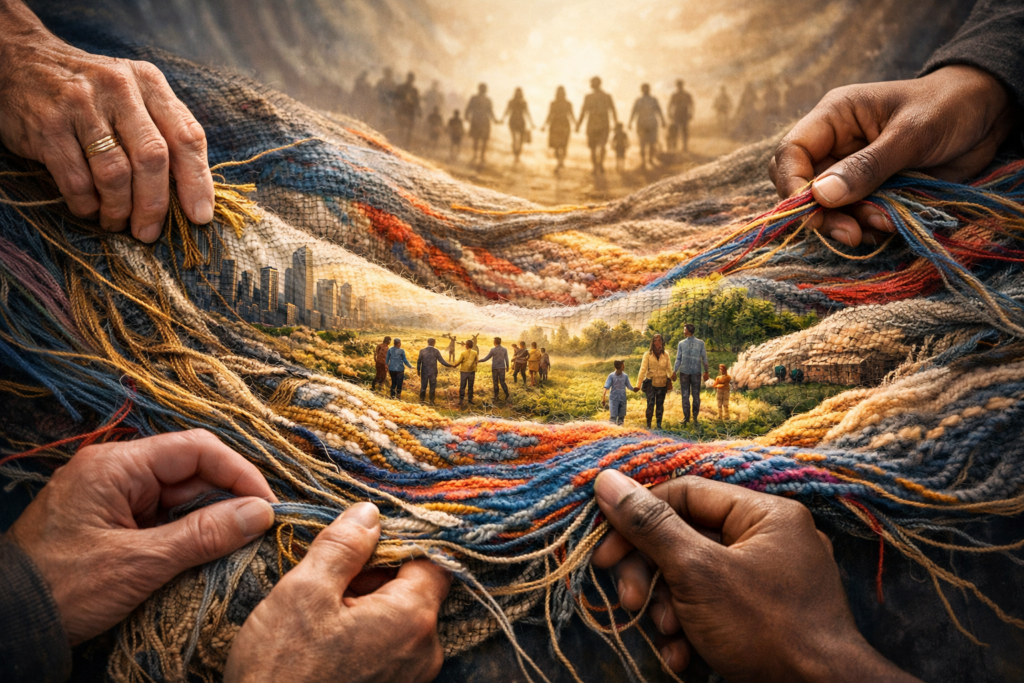
What Society Is—and What It Isn’t
Society refers to the organized patterns of relationships that connect individuals into a shared life. It includes the norms people follow, the institutions they rely on, the values they debate, and the informal networks that influence behavior. A society can be as small as a rural community with deep kinship ties or as large as a nation-state linked by laws, markets, and mass media. In all cases, society is not merely a crowd; it is a system—structured, evolving, and shaped by both cooperation and conflict.
It helps to distinguish society from related ideas. Culture is the shared meanings (beliefs, symbols, practices) through which people interpret life. The state is the political apparatus that makes and enforces rules. The economy organizes production and exchange. Society encompasses all of these, plus the everyday interactions that make rules and meanings real.
The Building Blocks of Social Life
Societies endure because they solve recurring problems: how to raise children, allocate resources, handle disputes, protect members, and create a sense of belonging. Over time, they develop stable patterns to meet these needs.
Norms and Values
Norms are expectations about behavior—what is considered acceptable, polite, or taboo. Values are deeper commitments about what is good or important, such as fairness, loyalty, freedom, or respect for elders. Norms can change quickly (for example, workplace etiquette), while values tend to be more enduring, though still contested across generations and groups.
Roles and Status
People move through society by occupying roles—student, parent, manager, neighbor—each with responsibilities and privileges. Status refers to social standing, which can be ascribed (such as age or family background) or achieved (such as educational credentials). Modern societies often claim to reward achievement, but ascribed advantages frequently shape who gets access to opportunities.
Institutions
Institutions are durable arrangements that organize important areas of life. Common institutions include:
- Family, which supports caregiving and socialization.
- Education, which transmits skills and legitimizes qualifications.
- Religion, which offers moral frameworks and community ties for many people.
- Economy, which structures work, income, and consumption.
- Government and law, which formalize authority and conflict resolution.
- Media, which shapes public narratives and collective attention.
Institutions create predictability, but they can also reproduce inequality when rules and resources favor certain groups.
How Society Shapes the Individual
No one is born knowing how to participate in social life. Through socialization, people learn language, norms, emotional expectations, and the subtle cues that govern interaction. Families teach early habits, schools teach schedules and evaluation, peers teach belonging and identity, and workplaces teach professional conduct.
Society also influences what people consider possible. It shapes ambitions, fears, and definitions of success. Even intensely personal choices—how to dress, whom to marry, what career to pursue—are made within a landscape of social expectations and constraints. At the same time, individuals are not passive. People negotiate, resist, reinterpret, and sometimes transform the very norms that shaped them.
Cooperation, Conflict, and the Question of Power
Societies depend on cooperation: shared roads, public health systems, trust in transactions, and mutual aid during crises. Yet conflict is not an exception; it is a normal feature of social life. Groups disagree over resources, recognition, identity, and authority. Power determines whose preferences become policy, whose stories become “common sense,” and whose needs are treated as urgent.
Power can be visible—laws, police, formal leadership—or subtle—social status, stigma, gatekeeping, and control over information. Understanding society requires asking: Who benefits from the current arrangement? Who bears the costs? And what mechanisms allow inequality to persist or be challenged?
Social Change: Why Societies Evolve
Societies are never static. They change through a mix of gradual shifts and sudden disruptions. Major forces that drive change include:
- Technology: innovations alter work, communication, surveillance, and culture.
- Demography: migration, aging populations, and urbanization reshape social needs.
- Economic transformations: recessions, globalization, and new industries reorganize class structures.
- Political movements: activism can expand rights and redefine citizenship.
- Environmental pressures: disasters and climate change force adaptation and collective planning.
Change often produces tension between generations, between city and countryside, or between groups with different moral visions. Some conflicts end in compromise; others yield long-term polarization. Healthy societies develop legitimate ways to process disagreement without treating opponents as enemies.
The Digital Turn: Community Without Proximity
Digital networks have reshaped society by changing how people meet, organize, and form identities. Online spaces can create belonging for marginalized groups and enable rapid collective action. They also intensify misinformation, harassment, and echo chambers that narrow perspective. Because online platforms are often governed by private incentives, the “public square” becomes vulnerable to manipulation—through algorithms that reward outrage, or through data collection that turns attention into profit.
The challenge is not simply to abandon technology but to build norms, regulations, and digital literacy that preserve open discourse while protecting dignity and democratic trust.
What Makes a Society Resilient?
Resilience is the ability to face shocks—economic downturns, pandemics, political crises—without tearing apart. Resilient societies tend to share several features:
- Trust in institutions and in one another, built through transparency and accountability.
- Social cohesion that allows diversity without forcing uniformity.
- Fair opportunity, where education, healthcare, and work are accessible and not determined solely by background.
- Rule of law, applied consistently rather than selectively.
- Civic participation, including volunteering, voting, local organizing, and constructive debate.
Resilience does not mean avoiding conflict; it means having shared commitments—such as dignity and fairness—that guide conflict toward repair rather than collapse.
Society as a Shared Project
Ultimately, society is a living fabric woven from everyday actions: the way people speak to strangers, the way employers value labor, the way communities treat newcomers, and the way governments respond to the vulnerable. It is also a shared project—something people inherit but also continually remake. When individuals recognize their interdependence, they can demand institutions that match human needs: security without oppression, prosperity without exclusion, and belonging without erasing difference.
To study society is to see that private life is never purely private and that public choices are never abstract. The quality of a society is measured not only by its wealth or power, but by how well it enables people to live with meaning, safety, and mutual respect.
More Articles Like: The Living Fabric: How Society Holds, Shapes, and Renews Us

Beyond the Headlines: Understanding the Rise of Alternative News
Alternative news has become a major force in the modern media landscape, offering audiences new perspectives, niche reporting, and challenges to mainstream narratives. Its growth reflects changing technology, public trust, and the demand for more diverse information sources.

Business Associations: How Collective Networks Strengthen Industries and Shape Growth
Business associations play a vital role in connecting companies, representing industry interests, and creating standards that support sustainable growth. From advocacy to training and networking, these organizations help businesses compete more effectively in changing markets.

Recreation Directories: The Smart Guide to Finding Activities, Parks, Clubs, and Local Fun
Recreation directories help people discover activities, facilities, clubs, and community programs in one organized place. They make it easier to compare options, save time, and connect with local opportunities for fitness, leisure, and family fun.